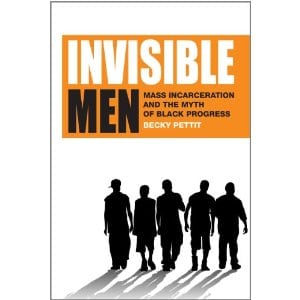
Everyone already knew that things were bad for black men–the high unemployment rates, the low high school graduation rates, etc., but it turns out things are probably even worse than you thought. Becky Pettit, a professor of sociology at the University of Washington, has written a new book, titled Invisible Men: Mass Incarceration and the Myth of Black Progress, which lifts the veil on the myth of black progress.
In a conference call with reporters, Pettit said that society had “developed a distorted idea” of how young black men are faring. The distortion began in the mid-70s when the number of prison inmates began to snowball. Data used to determine the unemployment rate and the employment to population ration reported by the U.S. Bureau of Labor Statistics are based on a survey of households; the survey does not consider people who are inmates of institutions, such as prisons or mental health facilities. Because black men are over-represented in the prison population as compared to their proportion in the general population, this dramatically skews the veracity of the claims government surveys make about the progress of American blacks.
According to Pettit’s calculations, the Bureau of Labor Statistics underestimate racial inequality in the high school dropout rate by 75 percent; overstate the employment rate of young, black male dropouts as 42 percent, while the employment rate is 26 percent when inmates are included; overestimated overall black voter turnout by 13 percent and turnout among young, black male dropouts by 64.2 percent.
“By systematically excluding inmates and former inmates from key data, we’ve clouded our understanding of the American political, economic and social condition,” says Pettit. “I hope that by bringing the mass of incarcerated people into public view, the book will give the public, social scientists and policymakers a more complete picture of our contemporary reality—and influence public policy debates accordingly.”
____________________________
Jamila Akil is a senior editor at Beyond Black and White. Follow her on Twitter @jamilaakil or email her at jamilathewriter-at-gmail-dot-com.



Some time back Attorney General Eric Holder commented that Americas are cowards in regard to discussing racial issues. I agree with that statement in general; however, not for the reasons he arrived at that destination. The tragedy is that (we) are cowards because the people who say we are cowards bash the lips off the faces of the people who dare to speak out about the problems facing the black community, proverbially speaking, particularly where black men and incarnation is concerned.
I can’t count the number of times I’ve heard people say something along the lines of this: “You’re not qualified to have an opinion on black men and incarnation, because you aren’t a black man, and you’ve never been incarcerated, and so you don’t know what it’s like.. So sit down and shut up!” Ok… I’ll sit down and shut up…. To me this creates a negative reinforcing cycle of desperation and perpetual victimhood that is used for political purposes by those very people who say I’m the coward… and this is the true shame and tragedy.
Yes, they are right, I have no clue what it’s really like to be black, and in jail; but that contrasts the opposite idea, that black man has no idea what it’s like to be white and free. I could be in jail… but I’m not… and it’s been no accident why this is the case! (Hold the fire) I feel that many of the people shouting down the discussion on race have deep rooted agendas to keep black men in chains, which is really sad; their relevance in society (the talking mouth-pieces), completely disappears if the black man is saved! Once they save the black man, their services are no longer needed so to speak. And that situation is hard on the not-for-profit’s income statement and cash flow report! They need men in chains… so as to justify the constant arguments, and fundraising drives on how to solve the dilemma… but without ever actually solving the dilemma.
Over or under representation of a demographic group in prison is really an irrelevant argument. If a particular demographic group is engaging in much higher rates of anti-social behavior, you can statically expect to see that group make up a larger share of the population of inmates. The answer is not to free violent men from prison just because… regardless of skin color, but to come to terms with why people choose to behave the way they do, and how exactly does that behavior results in success, or failure in life.
Q: How did my Mexican gardener in California, arrive in America as a child, with only the clothes on his back… having been towed by his parents 200 miles through the freezing desert at night, the scorching desert in the day time, and build a million dollar landscaping business over the course of his lifetime? Yet, Jamal cannot (or will not) escape Chicago, LA, or NYC… and never does he aspire, or dare to dream to be anything better than a part time worker at a hot dog stand?
I know, I know this big is a generalization… But I see this happen over and over and over again… and I keep being told to sit down and shut up by people like Eric Holder for merely noticing the correlations and asking why… and common ordinary guys like me, are beginning to reach our limits with this insanity… made to feel ashamed that a back kid in Chicago shoots three children in the face over $20 dollars in drugs… made to feel (by the talking mouth pieces) that I’m the WHOLE reason Jamal pulled the trigger.
And I just want to scream out at the top of my lungs, God Dammit Jamal, put down the fuc%ing handgun, follow my lead, or my former Mexican gardeners lead, and build yourself a better life! You can do it… no one else will do it for you… I will gladly show you how, but I guarantee it will not be easy! I can understand why so many black women are fed up with this too, and are now choosing to leave their race for dating and marriage prospects in ever larger numbers.
OK, I feel better now, and I’m not a coward for saying it… regardless of the fire I take!
- spam
- offensive
- disagree
- off topic
Like