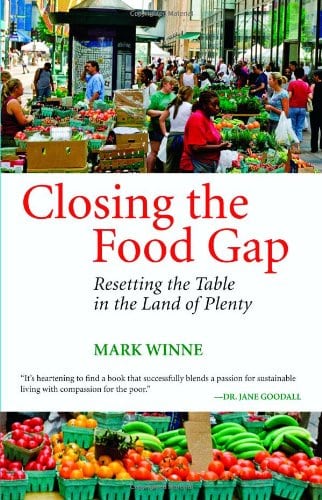
“Closing the Food Gap: Resetting the Table in the Land of Plenty,” a Book Review

“Closing the Food Gap: Resetting the Table in the Land of Plenty,” a Book Review

America is getting bigger. While population is growing so is the average size of the waistbands on Americans’ jeans. The expansion in the number of overweight Americans is partly explained by the lack of ability by poor people to purchase the kind of affordable and nutritious food which would keep them healthy and slimmer. The food gap, as Winne refers to it, is the gap between the ability of the middle- and upper-classes to access high quality, nutritious food at an affordable price and with relative ease, while on the other side of the chasm there are millions of poor people who lack access and an ability to pay for the same high-quality food as their middle-class neighbors.

Author : Jamila Akil

Author's Website | Articles from

America is getting bigger. While population is growing so is the average size of the waistbands on Americans’ jeans. The expansion in the number of overweight Americans is partly explained by the lack of ability by poor people to purchase the kind of affordable and nutritious food which would keep them healthy and slimmer. The food gap, as Winne refers to it, is the gap between the ability of the middle- and upper-classes to access high quality, nutritious food at an affordable price and with relative ease, while on the other side of the chasm there are millions of poor people who lack access and an ability to pay for the same high-quality food as their middle-class neighbors.

The U.S. Department of Agriculture conducts a survey every year which estimates the number of food insecure (i.e., food insufficient) Americans, normally between 10 and 12 percent of the US population. Food insufficiency can loosely be defined as ‘regularly running out of food or regularly not knowing where your next meal will come from.’ As of 2011, fifteen percent of the U.S. population, approximately 46 million people, live in poverty. Poverty and the concomitant problem of being unable to secure adequate nutrition is nothing new for Americans. Inability to purchase nutritious food on a regular basis may have once been even more of a problem than it is now; enough of a problem that ensuring the next generation received adequate nutrition to meet dietary needs was once a matter of national security, as Wynne explains:

“ During World War II, a significant number of men were rejected for military service because they could not pass the standard physical exam. Much of the blame for the high rejection rate was ultimately laid at the feet of poor nutrition. That so many young men had such substandard diets that they were unfit for military service was a matter of national chagrin and a threat to national security. This was the impetus for the creation of the national meal program to feed malnourished children and thus to ensure that the nation’s future soldiers were fit to fight its battles.”

With one foot firmly in the “land of personal responsibility and the other in the land of structural inequality”, Wynn takes the reader on a journey to explain why low-income Americans have a more difficult time purchasing affordable nutritious food.

Big-box retailers and national grocery store chains have been moving out of the city and into the suburbs in recent years for numerous reasons. For starters, the growing cost of maintaining insurance in communities with above average levels of crime, plus the need to standardize the size and shape of stores in order to reduce the costs of operation, have driven many grocery stores to leave the cities and move to surrounding areas in order to increase profitability. Urban density makes it difficult for the immense 18-wheeler trucks, which distribution centers use to deliver food, to maneuver down small, car-cramped urban streets or inside of small, outdated loaded docks at older food stores. Suburban communities have the space to build the loading docks and parking lots that newer larger grocery stores need.

Ethnic grocery stores and corner stores, both of which often lack a wide selection of fresh produce and meats, move into poor neighborhoods to fulfill the function–providing food–that the newer grocery stores have sidestepped. Local residents who want a fuller selection of fruits, vegetable, and meats than their corner grocer can provide often have to take bus rides of an hour or more to and from a larger grocery store; then the shopper is limited to bringing home what they can carry on a city bus. To avoid a long and tiresome trip, poor people often end up eating the food at the corner stores on a regular basis. Eventually, a lack of dietary diversity on a consistent basis leads to higher rates of obesity, diabetes, and other diet-related illnesses.

Capitalism is working just as it is supposed to: grocery store chains move to where they can achieve the highest profits and serve the greatest number of people; smaller stores step in to fill the niche left by the vacating stores. But this system does not serve the bodily needs of all people, thus it is inefficiency in a way that has less to do with profits and more to do with morals, ethics, and values. How do you feed the poor people in the food deserts, the people that the food system has literally deserted?

Mark Wynn offers a number of responses to the question of how to make sure that the least among us have access to the same high-quality, nutritious, and affordable food as the middle- and upper-classes and those who possess a car. Most of what Wynn suggests can be reduced to the idea that improving our food system will require more public-private partnerships: local and federal government agencies coming to the table and working with local farmers and private chains to make it profitable for food to reach those who need it.
_________________________________
Jamila Akil is a senior editor at Beyond Black and White. Follow her on Twitter @jamilaakil or email her at jamilathewriter-at-gmail-dot-com.


Be Sociable! Share!
Pinterest


Related Posts


Post comment as twitter logo facebook logo
Sort: Newest | Oldest
oceanspray 17 pts

Maybe there should be mobile grocery trucks/vans in poor communities. That cuts costs of insurance and the threat of being robbed. The food truck can have a little jingle like the ice cream truck.


This topic is fascinating to me. I've just returned from America from abroad. I've been back one month and I can see my country through outsider eyes. Body weight/type is the number one way for me to tell a person's class and lifestyle in America.( Except for black women there is not much of a positive correlation in economic class and thinness.) Since I'm home in South Florida, a thin and fit black woman is usually from the Islands or is a teenager in sports at school.

oceanspray 17 pts

Also, for me, I'm experincing the US from a different vantage point. I lost weight (30 lbs) while I was in AUstralia. And it's really great being thin here. It's like instant status upgrade. It's easier to be cute without trying. I can make an impression just with some tight fitting skinny jeans and sandals. It's nice wearing little dresses/shorts as well while walking on the beach.

Brenda55 19276 pts moderator

 oceanspray Congratulations on your weight loss.

To what do you attribute it to?

Was you loss by intent or was it tihe diffrence in the food in Australia.   A lot of the food if processed here in the US and is full of high fructose Corn syrup which we are finding is the cause of much of the type 2 diabetes.  There is also an abundance of fast food.. 


When I was in Uruguay and Argentina I found the food to be much less processed and there were few fast food resturants so the meals were a lot heather.

Did you find that to be the case in Australia?


oceanspray 17 pts

 Brenda55

 Hi Brenda,


My weight loss was  the result of a combination of things, but mainly it came down to working out everyday, elimination of white carbs/fried foods/crap and cutting my meal portions in half. I lived near the beach and mountains in AU so I would run and swim everyday. It was great for mind, body and spirit.


The Australians also eat less junk food than Americans. There are less fast food places. (But there are a lot of them still) Also the sweets usually used real sugar instead of high fructose corn syrup. It is their culture to drink tea alot instead of soft drinks. The cultural differences in AU were contributing factors. But the main reason behind my weight loss; I decided that I wanted to be thin. I was tired of being chunky. I was a US size 12 at 5'7. I didn't realize how bad I looked until my friend from university came to visit me in AU, and posted our photos on facebook. And I saw how bad I looked from different angles. (And I thought I looked cute in that little jean skirt.) I was upset for one month, then the nextmonth I started to diet. I went no carb for a month and slowly increased excerise. Then I continued to increase excercise up to an hour a day nd incorporated juicing into my high protein/veggie diet. It took 4 months to lose the weight, then 4 more at the gym toning up with weights. And ow I'm just in maintenance mode. I changed my entire lifestyle while in AU, now I just have to keep  in up in USA and where ever else I travel. Now I'm a US size 4-6. Now that I'm home, I go with my mom to her gym everyday. I work out with her personal trainer. According to him I'm 21% body fat, which I guess is good.

Brenda55 19276 pts moderator

" For starters, the growing cost of maintaining insurance in communities with above average levels of crime"


This is the number one reason that the price of food in poor urban communities is so expensive and why there is little access to it and many other goods and services.


 We read frequently of store owners who are victims of crime in these communities whose only sin was attempting to serve a population who needed the goods and service they were providing. You learn quickly to set up shop elsewhere.  


Sure the government  can fund improvements in infrastructure and the farmers and wholesalers can get the food on site but it cannot fix the crime issue by stopping pilfering, armed robbery or the murder of merchants and their employees trying to make a living in war zones. The rest of us who can just avoid these areas. I know I do.  No need to risk crossing paths with the predators who live in these communities and the don't snitch culture that enables and gives the predators cover when you don't have to.


What is an outsider to do when the men of those communities will not check the destructive behavior of their brothers and sons or at the very least organize to protect the people trying to provide the service to the women and children living in their midst?  

Law Wanxi 5775 pts

 Brenda55 

Ah, the elephant in the room; violent crime and the criminal-friendly culture of the inner city. Anyone who is foolish enough to broach the topic is a hater and a racist. So, we all just move away and leave it to fester and spread. 


It's amazing how quickly the explanation of why Kwame shot the Chaldean store owner and his wife heads into an explanation of The Legacy Of Slavery and White Privilege, when the BC leadership bemoans 'Another Young Brother In Prison'. Extra points given for less than 500 words.

Brenda55 19276 pts moderator

 Law Wanxi  

I know.  You would be a racist for saying what I just posted and I am a sellout and race traitor for posting it in the first place.


So. Be. It.


Sorry I nave been a victim of of property crime, I have been mugged and have had a loved one murdered and have had to deal with the terrible aftermath. Try cleaning up the room once the police and the ME is finished their investigations. Try going to the ME to ID you kin and seeing what the criminal left for you to ID. Try staying up night after night with your mom and sister who found the corpse in place. 


I have relatives who are on drugs and who are in the drug game so I am very well familiar with at elephant. I have earned the right to hold whatever opinion I choose to. 


So long as communities are too dangerous for decent, normal people to live and work in there will be no investment in those communities. Violent communities do not get that way over night it is gradual and the people who see the change and cannot stop it leave.

 Other avoid moving there. It is just self preservation and common sense.   People can call that racism and selling out all they want. Fine. 

Law Wanxi 5775 pts

Maybe if you had titled this highly informed and relevant post "Fresh Meat!!! Rihanna, Chris and Nutrition!!!" more people would have read it. 


"more public-private partnerships: local and federal government agencies coming to the table and working with local farmers and private chains to make it profitable for food to reach those who need it."


I have an even better idea. Pick a centrally located and transit-accessible location, then have the city take an entire block via eminent domain proceedings. People will scream "COMMUNISM!!!", but if that's true, then most cities with NFL, NBA, NHL and MLB facilities are communist. Cities routinely take away homes and businesses for pennies on the dollar, if they even deign to do that, for sports stadiums and no one cares or dares object. Go ahead, make my day; name a city that hasn't for at least one of its sports franchises.


Even oh so holier than thou LA did it in spades to the people of Chavez Ravine. 

http://en.wikipedia.org/wiki/Battle_of_Chavez_Ravine

The Real Americans got their sports. The unintended consequence was the start of Latino political involvement from voter registration to reconquista. Viva MEChA!


All right, I know that sports is bigger than God in the USA, and is immune from anti-trust laws, common sense, viable business models and is more above criticism than the Pope inside The Holy See, but let's get real here. This is my proposal.


Find an nice location, condemn an entire block and have the city/state/fed put up a state of the art modern supermarket structure with three-bay loading docks. The city will own the building and they should lease it to an EXPERIENCED huge supermarket operator like Kroger. Kroger operates highly differentiated purchased chains in the same area without much commonality of store format. They can do a special stock store for the inner city.


As a sop to the 'ethnic markets' who sell mostly semi-toxic crap, booze and tobacco products [along with under the counter drugs and porn], the new store would not sell alcohol, tobacco or a full line of empty-calorie snacks. The floor space that would normally go for that could be used to set up a demonstration kitchen and an area that would provide nutrition and healthy cooking instruction. Set up outreach partnerships with local schools of dietetics/nutrition and have students rotate through, along with students from local culinary schools.


Provide the needed security to make it all work, including allowing a local large bank to have an in-store branch or at least a local, large credit union. Do what is needed. Build it and they will come.


I'm dreaming, of course. It won't happen. It would help inner-city women and their children which is not on anyone's agenda. 


It sure would be nice, though.


MixedUpInVegas 1643 pts

Smaller, more agile food vendors like farmers markets would help these communities. People within the food deserts could organize a weekly market that would bring fresh produce and dairy to those people. The bottom line, though, would be to make it safe for the vendors and the patrons. In addition, encouraging backyard gardens would be a good idea. There is a movement going on to have a little "victory garden" in the yard. I grow a lot of my own vegetables in my small city yard. It's not difficult.

FriendsofJay 1807 pts

Living in a redneck, blue collar area, the first thing I noticed as a kid was that poorer people had a dinner of "meat and potatoes," unlike dinners at my house.    Vegetables and fruit were a rarity.  Of course, fresh fruits and vegetables have always been expensive and if a mother saw that green beans were $3.99 a pound and so was ground beef, she probably thought that it would be more practical to buy the meat.  The kids in the family came to think that vegetables weren't very tasty and so when they grew up they continued this habit with their own families------even if they made more money.  Also, poorer people eat a lot of fast food which is full of fat and empty calories and grow fatter and heavier.  Being poor with this kind of diet meant skinny kids and fat adults.  These mothers knew very little about nutrition.  The better off kids, like me, learned it at home and it was reinforced at college.  Even with food stamps, poor mothers continue to buy filling and fattening food because they're cheaper and they go farther.  The government should make nutrition classes compulsory for food stamp recipients so that they could make nutritious diets for their families for the same money they spend on fattening food.  My mom told me that you can have near gourmet quality meals for very little if you buy a cookbook, learn cooking basics and not be afraid to experiment.  I do the cooking at my house and we have gourmet Marrakech chicken for four people (me, my wife and another couple), including a decent wine for $20.00.  I notice that many heavy set families have pizza, Big Macs and hoagies way too often.  That's why government nutrition classes should be a must.